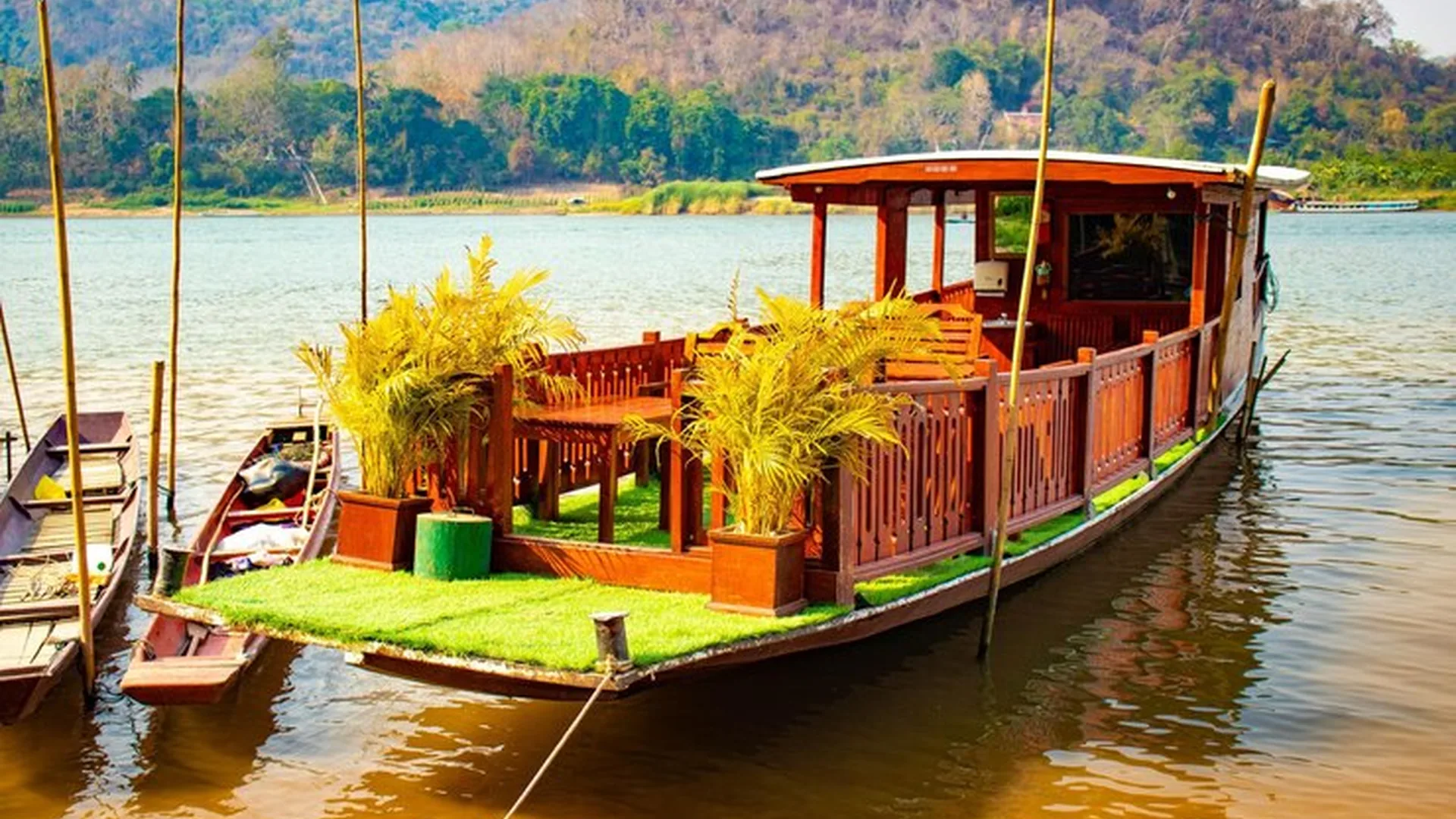
Laos is not a difficult country to travel in. It is, however, a country that rewards travellers who plan with intent. Most published travel guides cover three or four destinations and call it the country. This one covers all fourteen — from the capital to the karst country, the Mekong heritage to the river highlands, the revolutionary caves of Sam Neua to the four thousand islands at the Cambodian border — written from the inside, with the minimum nights each destination earns and the reasons why.
Quick Facts — Laos in 2026, At a Glance
- Capital: Vientiane
- Currency: Lao kip (LAK), ~21,500 LAK = 1 USD
- Language: Lao, English in tourist areas
- Time Zone: ICT, UTC +7
- Electricity: 230V, Type A, B, C, F plugs
- Visa: eVisa or Visa on Arrival, USD 30 to 50
- Best Months: November to February, cool and dry
- Green Season: June to September, lush and quiet
- International Airports: Vientiane (VTE), Luang Prabang (LPQ), Pakse (PKZ)
- Land Borders: Thailand, Vietnam, China, Cambodia
What follows is the long answer. If you only have time for the short one: come for the north on a first visit, give yourself ten days at minimum, fly in to Luang Prabang or Vientiane, take the China-Laos Railway between them, and use a private licensed guide if you want to understand what you are looking at. The rest of this guide is for the people who want more than the short answer.
The Geography of Laos — North, Central, South
Laos is shaped by the Mekong. The river is the country’s western edge from north to south, and almost everything that matters in Lao history, culture, and travel sits along it or feeds into it. Knowing this geography is the foundation of planning a trip well.
The country divides naturally into three regions. Northern Laos is mountainous and river-driven — limestone karst valleys, the Nam Ou and Nam Khan tributaries, the UNESCO-listed royal city of Luang Prabang, the ethnic highlands, and the revolutionary heritage at Sam Neua. The north is where most travellers start, and rightly so. Central Laos runs from Vientiane south through Khammouane and Bolikhamxay provinces — flatter, less visited, and home to one of the great cave systems in Southeast Asia at Konglor. Southern Laos is gentler again — the Bolaven Plateau and the Aboriginal Tribal Loop™, the pre-Angkor Khmer ruins at Vat Phou, and the Mekong’s most extraordinary expression at the 4,000 Islands.
A Note on Direction “North to south” is the natural narrative of the country, but it is not always the right travel order. If you are flying into Vientiane and have only a week, the smarter route is Vientiane → Vang Vieng → Luang Prabang and out — south to north. The river flows south, but the country opens northward.
The Fourteen Destinations — At a Glance
Brother Tours covers fourteen distinct travel destinations across Laos. Each one carries a recommended minimum night count, drawn from fifteen years of guiding the country at private signature standard. The minimums are honest — they are the night counts at which a destination starts to reveal itself rather than simply pass by. Stay longer if you can; the country rewards time.
| Destination | Region | Min. Nights | Anchor |
|---|---|---|---|
| Vientiane | Central | 1 (ideal 2) | The capital · cultural gateway · arrivals |
| Vang Vieng | Central | 2 | Karst country · soft adventure · hot-air balloons |
| Luang Prabang | North | 2 (3–4 ideal) | UNESCO heritage · monasteries · Mekong-Khan confluence |
| Nong Khiaw | North | 2 | Nam Ou river country · karst cliffs · ethnic villages |
| Xiengkhouang | North | 2 | Plain of Jars · UNESCO · Secret War history |
| Oudomxai | North | 2 | Working highland junction · Khmu villages · Chom Ong cave |
| Pakbeng | Far North | 2 (not 1) | Mekong slow boat · ethnic villages · founder’s home country |
| Luang Namtha | Far North | 2 (up to 5) | Nam Ha Protected Area · jungle trek · ecotourism |
| Sam Neua & Viengxay | Northeast | 2 (3 ideal) | Birthplace of Lao PDR · revolutionary caves · textile country |
| Konglor | Central | 2 | 7.5km river cave · The Rock viewpoint · fastest-growing |
| Thakhaek | Central | 1 (Loop riders longer) | French colonial gateway · Thakhaek Loop · transit |
| Savannakhet | South-Central | 1 | Southern gateway · colonial heritage · Vietnam crossing |
| Champasak Province | South | 2 (3 ideal) | Bolaven Plateau · Wat Phou · Aboriginal Tribal Loop™ |
| 4,000 Islands | South | 2 | Si Phan Don · French railway · Mekong archipelago |
Build It Yourself
Brother Tours runs an interactive builder where you select the destinations that matter to you, set the night count for each, and receive a private fitted quote within 24 hours. A pace calculator flags when a route is too compressed for the time available.
Northern Laos — The Mountains and the River
Northern Laos is what most people picture when they picture Laos. Misty river valleys, limestone karst rising vertically out of forest, hill villages, and the saffron of monks at dawn in Luang Prabang. This is where the country’s cultural depth runs deepest, and where almost every first-time itinerary should begin. Eight of the fourteen destinations sit in this region.
Luang Prabang — UNESCO · The Heritage Anchor · 2–4 nights
The heritage anchor of Laos and the only destination on this list with a genuine three-tier minimum. The old royal capital, the spiritual heart of the country, and the only town in Southeast Asia that combines French colonial architecture, golden-roofed Buddhist temples, and a riverside setting at the confluence of the Mekong and Nam Khan. UNESCO listing in 1995 protected the architectural fabric. The Tak Bat alms procession at dawn remains a daily monastic ritual, not a performance.
Two nights covers the essentials — Tak Bat at dawn, the morning market, Kuang Si Falls, and the UNESCO heritage walk through Wat Xieng Thong and the Royal Palace Museum — but two nights is fast. Three nights is the proper minimum if you want to read the town rather than rush through it. Four nights is where insider depth begins: the Buffalo Dairy Farm community, the bear rescue sanctuary, the textile villages on the way back from Kuang Si, the Living Farm visit, the Baci ceremony at sunset.
A Founder’s Note If you have only one extra night to spend across your whole trip, spend it in Luang Prabang.
- Gateway — Luang Prabang International Airport (LPQ) · 20 min from old town
- Rail — China-Laos Railway · Vientiane in under 2 hours
- Stay — Old town for atmosphere · Chompet for quiet
- Pace — Slow · 3 nights minimum, 4 ideal
Nong Khiaw — Nam Ou River Country · 2 nights minimum
Nong Khiaw is the most photographed riverside town in northern Laos and one of the strongest natural anchors in the country. The Nam Ou runs deep green between three-hundred-metre limestone cliffs; the working pace is slow and river-led, with long-tail boats moving up and down between the small ethnic villages of the upper Nam Ou.
Two nights is the working minimum because the format only works if you have one full day on the river — the morning Nam Ou cruise upstream, visits to working Hmong and Khmu villages along the bank, the light hike to Tad Mok Waterfall, and the buffalo trail walk back through agricultural country. The combination of two nights at Nong Khiaw plus three nights at Luang Prabang is the strongest five-night anchor in the north.
Vang Vieng — Karst Country · 2 nights minimum
Vang Vieng has reinvented itself. The party-town reputation from fifteen years ago is gone; the town now anchors the country’s strongest soft-adventure register at the foot of dramatic limestone karst country. Two nights is the minimum because the format only works if you have one full day for the natural circuit — Tham Xang (Elephant Cave), the Hmong village hike to Ban Phathao, the kayak run on the Nam Song, the lagoons and viewpoints around the southern edge of town.
Travellers who only stop one night arrive late, photograph the karst, and leave. Travellers who stay two nights actually walk into the country. The drive from Vientiane runs about three and a half hours via the Nam Ngum valley; the China-Laos Railway shortens it dramatically and is worth using on either the inbound or outbound leg.
What is worth your time:
- Hot-air balloon at dawn — the best view of any karst landscape in Southeast Asia
- Blue Lagoon 3 — quieter than Blue Lagoon 1, equally beautiful
- Tham Phu Kham cave with a reclining Buddha at the entrance
- Kayaking the Nam Song through the karst
Xiengkhouang & the Plain of Jars — UNESCO · 2 nights minimum
Xiengkhouang holds the Plain of Jars — three of the seven main UNESCO-inscribed sites are accessible by car from Phonsavan town, and the editorial register is unlike anywhere else in mainland Southeast Asia. Bronze-age stone vessels scattered across high plateau country, carved between 1,500 and 2,000 years ago, set against a landscape that still carries the visible legacy of the Indochina conflict.
Two nights minimum because the day-tour version does not work — the sites are spread across kilometres of plateau country, and the cultural context (the Hmong community, the working ethnic agriculture, the UXO clearance operations still ongoing) requires time to read. The MAG centre and the Xieng Khouang UXO Visitor Information Centre tell the Secret War history plainly.
- Sites — Jar Site 1, 2, 3 · cleared and signposted
- History — Hmong New Year in late Nov / Dec · the cultural moment of the region
- Travel — Internal flight from Vientiane or Luang Prabang · 35 min
Oudomxai — Working Highland Junction · 2 nights minimum
Oudomxai is the working highland junction of northern Laos — the road and rail intersection where the country’s northern routes meet. Most travellers pass through; we recommend two nights for travellers drawn to the working register of upland Laos beyond the heritage and the karst country. The town itself is a small provincial centre; the country around it is the editorial value — Khmu villages, working agricultural valleys, the highland markets, and access to the Chom Ong cave system that few foreign travellers reach.
Oudomxai works best for travellers building longer northern routes that connect Luang Namtha or Sam Neua, or for travellers who want a working junction-town night between the heritage country and the deeper north. The kind of stop that turns a generic northern route into a journey.
Pakbeng — Mekong Slow Boat · 2 nights (not 1)
Most operators treat Pakbeng as a one-night gateway between Houayxai and Luang Prabang on the Mekong cruise — guests arrive in the late afternoon, sleep, and leave the next morning.
This is the wrong call. Pakbeng deserves two nights, and the day between the arrival night and the departure morning is the most editorially rich day on the entire upper Mekong route.
A Founder’s Note · The One Most Operators Get Wrong I grew up in the upper Mekong country and walked the road from my village to this area for school. The villages around Pakbeng are not a tourist circuit. They are working ethnic communities — Hmong at Ban Pha Deng, Khmu and Tai Lue at Ban Thong — and the difference between a one-night Pakbeng and a two-night Pakbeng is the difference between a Mekong cruise and a Mekong journey.
The second full day works the working ethnic villages of the Pakbeng hinterland with a packed picnic lunch prepared by the village families. This is the day that turns the slow boat from a transit segment into the editorial centre of a northern Laos trip.
- Arrival — Late afternoon by Mekong slow boat from Houayxai
- Day 2 — Ban Pha Deng (Hmong) · Ban Thong (Khmu & Tai Lue)
- Departure — Day 3 morning · downstream to Luang Prabang
Luang Namtha — Nam Ha Protected Area · 2 to 5 nights
Luang Namtha is the country’s strongest ecotourism anchor — the gateway to the Nam Ha National Protected Area, one of the most biodiversity-rich tropical forests in mainland Southeast Asia. The destination operates on a tiered commitment.
- 2 nights — single-day ethnic village trek and a town-and-country circuit
- 3 nights — proper two-day jungle trek with overnight in working ethnic villages
- 5 nights — the full deep-jungle expedition
The 5-day trek is the country’s most challenging soft-adventure experience — sleeping in working Khmu, Lanten, and Akha villages, walking through primary forest with local guides, hand-line fishing in the Nam Ha tributaries, and reading the country at the rhythm of the communities that live in it. The country’s best-kept ecotourism secret, and the destination most likely to convert a traveller from “I went to Laos” to “I am going back to Laos.”
Sam Neua & Viengxay — Birthplace of Lao PDR · 2–3 nights
Sam Neua and the nearby Viengxay caves are one of the country’s most editorially significant destinations and one of the least visited. The Viengxay cave complex was the headquarters of the Pathet Lao revolutionary government during the Indochina conflict — an underground city carved into limestone karst that housed the country’s leadership, including a fully equipped hospital, theatre, military command, and family quarters.
The Lao PDR was effectively governed from these caves between 1964 and 1975, and the site is the founding place of the modern country. The cave tours run twice daily, and the surrounding country — the working ethnic villages, the highland Hmong communities, the regional markets, and the textile country toward Sam Tai — deserves time.
A Premium Specialist Destination This is the destination most operators do not sell, and the one we consider the most editorially significant in the country. Best reached by domestic flight from Vientiane to Sam Neua.
- Access — Lao Airlines flight Vientiane → Sam Neua (NEU)
- Min — 2 nights · 3 nights ideal
- Pair with — Sam Tai textile villages · the road to Phonsavan
Central Laos — Vientiane to Konglor
Central Laos is the part of the country most travellers fly over rather than into. That is a mistake for travellers with time. The capital, the Mekong heartland of Khammouane, and the great cave at Konglor sit here, along with some of the country’s most undeveloped national parks. Three destinations cover the region — Vientiane, Konglor, and Thakhaek.
Vientiane — The Capital · 1 night minimum, 2 ideal
Vientiane is one of the smallest, quietest national capitals in Asia — and that is the central thing to understand about it. There is no metro, no traffic gridlock, no high-rise skyline. The pace is set by the river, the bicycles, and the temple bells. For most leisure travellers, Vientiane works as a 1-night stop on arrival or departure, or 2 nights for a properly unhurried introduction to the country.
What is worth your time:
- Pha That Luang — the national symbol, gold-plated stupa, central to Lao identity
- Wat Si Saket — the oldest temple in the city, walls lined with 6,800 Buddha images
- Haw Phra Kaew — once home to the Emerald Buddha
- The COPE Visitor Centre — the human story of UXO clearance in Laos, essential context
- Patuxai — the Lao Arc de Triomphe, climbable for a view across the city
- Buddha Park (Xieng Khuan) — a 1958 sculpture garden on the Mekong
- Sunset along the Chao Anouvong riverside, with grilled fish and Beerlao
One night gets you the airport-to-airport function; two nights lets the city actually open up. Travellers on business have different needs and may legitimately need longer.
Konglor — Fastest-Growing Destination · 2 nights minimum
Konglor has become one of the fastest-growing destinations in Laos in the past three years. The 7.5-kilometre Konglor Cave is one of the longest navigable river caves in mainland Southeast Asia — guests transit by long-tail boat through the karst mountain, emerging on the other side. New infrastructure has added The Rock viewpoint and a working zipline experience that sits comfortably alongside the cave anchor without overshadowing it.
Two nights minimum to handle the cave traverse properly (it takes most of a day), The Rock viewpoint at sunset, and the surrounding karst country. Konglor sits well as the central anchor on a 7–10 day route that runs Vientiane → Konglor → Thakhaek loop → southern Laos. For travellers wanting karst country without the Vang Vieng tourism level, Konglor is the answer.
Seasonal Note Konglor and the karst cave systems operate reliably from November to early May. During heavy green season rains, water levels can rise enough to close cave access. Plan around this if cave travel is the priority.
Thakhaek — Central Gateway · 1 night (Loop riders longer)
Thakhaek is the central gateway between northern and southern Laos — most travellers pass through on overland routes, and one night is the working minimum. The town itself has French colonial heritage worth a half-day walk, particularly the riverfront colonial houses and the Thakhaek market.
The destination earns longer stays only for adventure travellers and backpackers riding the Thakhaek Loop motorbike route, which runs four days through the karst country east of town and connects with the Konglor area. For the standard fitted private traveller, Thakhaek is a 1-night gateway stop. For motorbike adventurers and cave enthusiasts, it can anchor a 4–7 day loop with overnight stops at remote guesthouses.
Southern Laos — The Mekong, the Plateau, and the Aboriginal Tribal Loop™
Southern Laos is what travellers visit when they have already seen the north, or when they are drawn specifically to coffee, rivers, and a slower pace. Three destinations cover the region — Savannakhet, Champasak Province, and the 4,000 Islands — though Champasak itself is a layered destination spanning Pakse, the Bolaven Plateau, Wat Phou, and our trademarked Aboriginal Tribal Loop™ route.
Savannakhet — Southern Gateway · 1 night minimum
Savannakhet is the working southern gateway between Laos and Vietnam — the second-largest city in the country, with a strong French colonial heritage core and a working Mekong front. One night is the honest minimum; the city does not sustain a longer stay for most leisure travellers, and the editorial value is concentrated in a half-day heritage walk through the colonial quarter, the working market, and the Mekong promenade.
Savannakhet works best as a 1-night break on overland routes between southern Laos and Vietnam, or as an inbound entry point for travellers crossing from Mukdahan in Thailand. An honest one-night gateway, no apologies needed.
Champasak Province · Pakse, Bolaven & Wat Phou — The Southern Anchor · 2–3 nights
Champasak Province is the editorial anchor of southern Laos. Most travellers know it by Pakse (the provincial capital and gateway) but the destination’s three working anchors all sit outside the city — the Bolaven Plateau to the east (Paksong, the coffee highlands, the waterfall circuit, and the Aboriginal Tribal Loop™ visits to the Alak, Katu, Laven, and Ta-Oy communities); the pre-Angkorian heritage at Wat Phou to the southwest (UNESCO-listed Khmer temple complex predating Angkor Wat by roughly four hundred years); and the working Mekong river country south of the city.
Two nights minimum to cover the Bolaven Plateau, three nights ideal to add Wat Phou and the Champasak heritage country. The Aboriginal Tribal Loop™ is our trademarked route through the working Mon-Khmer ethnic communities of the Bolaven — the most editorially rich cultural register in southern Laos and a route no other operator can offer under this name.
The Bolaven layer:
- Tad Fane — Twin 120m waterfalls · short walk · viewpoint
- Tad Yuang — Bathing pool below the falls · cooler air
- Coffee — Working estates, Lao coffee at source
- Aboriginal Tribal Loop™ — Alak · Katu · Laven · Ta-Oy communities
The Wat Phou layer:
A 7th-century Khmer mountain sanctuary, UNESCO-listed in 2001. The site climbs a sacred mountainside toward a natural spring, with the central shrine still in active worship. Half a day on site, ideally at first light or late afternoon. Stay in the village of Champasak across the river — small, riverside, and quieter than Pakse.
Si Phan Don — The 4,000 Islands · 2 nights minimum
The 4,000 Islands (Si Phan Don) is where the Mekong spreads to fourteen kilometres wide at the southern delta of Laos — one of the most editorially distinct landscapes in mainland Southeast Asia. The two main inhabited islands, Don Det and Don Khone, anchor the destination; the islands have no cars, only tuk-tuks and bicycles, and the working pace runs at the rhythm the Mekong allows.
Two nights minimum because the format only works if you have one full island day — the colonial French railway across Don Khone (the only European-standard railway in colonial Indochina), the historic French steamship port, the suspension bridge between the two islands, and Li Phi Falls. Combined with 2–3 nights at Champasak, this gives the 4–5 night southern minimum that earns the long flight or drive south.
What is worth your time:
- Khone Phapheng Falls at full flow — the widest waterfall on Earth, late green season is most dramatic
- The French colonial railway on Don Khone — walkable, lined with bougainvillea
- Li Phi (Tat Somphamit) — the second of the great Mekong falls
- Irrawaddy dolphin watching from the southern tip of Don Khone — critically endangered, observed responsibly
- Sunset over the Mekong from a hammock on the eastern shore of Don Khone
Four Reference Routes — How to Combine the Fourteen
Four reference routes built from the destinations above. These are not catalogue products — they are starting points for a private custom journey, and any of them can be lengthened, shortened, or recombined around your dates and interests.
Reference Route One · 7 Days — The First-Time Northern Essential
Vientiane — Vang Vieng — Luang Prabang
Two nights in the capital, two nights in the karst country, three nights in the heritage town. The strongest 7-day introduction to the country, working the cultural anchors, the soft adventure register, and the heritage core without rushing. Best for first-time travellers and limited time windows.
Reference Route Two · 10 Days — The Northern Mekong Journey
Pakbeng — Luang Prabang — Vientiane
Two nights in Pakbeng (with the village country day in the upper Mekong), four nights in Luang Prabang, two nights in Vientiane. Built around the slow Mekong cruise and the heritage anchor. This is the route our Women of the Mekong signature runs at small-group standard.
Reference Route Three · 14 Days — The Full Country Read
Vientiane — Vang Vieng — Luang Prabang — Champasak — 4,000 Islands
The country end-to-end with two domestic flights covering the long distances. Two nights in the capital, two in Vang Vieng, four in Luang Prabang, two on the Bolaven, two on the islands. Comfortable pace, full country coverage, the right length for a country-defining trip.
Reference Route Four · 12 Days — The Specialist Second Trip
Vientiane — Sam Neua — Xiengkhouang — Nong Khiaw — Luang Prabang
For travellers returning to Laos who have already covered the standard anchors. Three nights in Sam Neua (the Viengxay caves and the revolutionary register), two in Xiengkhouang (the Plain of Jars), two in Nong Khiaw (the river country), three in Luang Prabang. A route most operators cannot build.
Or Combine Them Yourself
The interactive trip builder lets you tap the destinations that interest you, set the night count for each, see your pace assessment in real time, and submit a brief that our team will quote within 24 hours.
When to Visit Laos in 2026
Laos has three seasons: cool dry, hot dry, and green. The honest version of the seasonal calendar follows.
| Season | Months | Temperature | What It Delivers |
|---|---|---|---|
| Cool Dry | Nov – Feb | 18°C – 28°C | Best weather. Clear mornings, low humidity, the Mekong at its calmest. Peak season — book early. |
| Hot Dry | Mar – May | 30°C – 38°C | Hazy from agricultural burning in March/April. April brings Boun Pi Mai — the Lao New Year, the country’s biggest festival. |
| Green | Jun – Sep | 24°C – 32°C | Rain in afternoon bursts, not all-day downpours. Landscape at its most beautiful. Lowest prices, fewest crowds. |
| Transition | October | 22°C – 30°C | The smartest single month. Rain easing, landscape still green, peak-season prices not yet in effect. That Luang Festival mid-month. |
Our Strong Preference October and late February are the two best weeks of the year to travel Laos. Better light, better prices, fewer crowds, and full operational access to every region. November to January is more reliable for weather but more competitive for accommodation.
For the full month-by-month breakdown including festival calendar, see our companion piece — the Best Time to Visit Laos: A Month-by-Month Honest Guide.
Entry to Laos — Visa, eVisa, and the Arrival Card
Laos has one of the more straightforward entry regimes in Southeast Asia. Most travellers will use one of three routes: an eVisa applied for online before travel, a Visa on Arrival at one of the main entry points, or visa-free entry if their passport qualifies.
The Lao eVisa — Recommended for 2026
Apply at the official Ministry of Foreign Affairs portal: laoevisa.gov.la. Cost is USD 50 (single entry, 30 days). Processing time is three business days. Approval arrives by email as a PDF — print two copies and save a digital backup. The eVisa is accepted at all six international airports, the major Thai-Lao Friendship Bridges, and the Vietnam, China, and Cambodia border crossings.
Watch the URL Several copycat sites charge inflated processing fees on top of the government cost. The only official portal is laoevisa.gov.la. If a site is charging USD 80 or more and is not the .gov.la domain, it is a third-party reseller, not the government.
Visa on Arrival (VoA)
Available at Wattay International Airport (Vientiane), Luang Prabang Airport, Pakse Airport, all four Thai-Lao Friendship Bridges, the Boten crossing from China, the Daensavan crossing from Vietnam, and the Veunkham crossing from Cambodia. Cost is between USD 30 and USD 50 depending on your passport. You need: passport with six months validity and two blank pages, one passport photo (4×6 cm), exact USD cash, and a completed entry card.
Visa-Free Entry
ASEAN passport holders (Thailand, Vietnam, Cambodia, Malaysia, Singapore, Indonesia, Philippines, Brunei, Myanmar) enter visa-free for 14 to 30 days depending on bilateral agreement. Japan, South Korea, Russia, China, and Mongolia also have visa-free agreements for 15 to 30 days. The full current list is maintained on the Lao Immigration website.
The Lao Digital Immigration Form (LDIF)
Introduced in late 2025 and now standard for 2026. The LDIF is an online arrival declaration you complete before you fly. It does not replace the visa — it sits alongside it. Pre-filling the LDIF shortens your time at the immigration counter. The physical arrival card distributed on incoming flights remains accepted and reliable; submit both if you can.
Visa Extensions
Tourist visas (eVisa and VoA) can be extended once, for up to 30 additional days, at immigration offices in Vientiane, Luang Prabang, and Pakse. The fee is approximately USD 2 per day. Overstaying carries a fine of USD 10 per day and risks complications on departure.
From Ken In fifteen years, I have seen one consistent mistake on entry: damaged USD notes. The visa counter routinely refuses bills that are torn, marked, or pre-2013 series. Bring crisp, clean notes in small denominations — USD 1, 5, 10, 20. The full visa fee in exact change.
Exit from Laos — Departure, Tax, and Border Crossings
Exiting Laos is simpler than entering. There is no separate departure tax to pay at the airport — it is included in your airline ticket. The key practical points are documentation, timing, and which exit point you use.
At the Airport
Arrive at Wattay (Vientiane), Luang Prabang, or Pakse international airports at least 2.5 hours before international departure. The airports are small and processing is fast, but security and immigration queues can build during the November-to-February peak. Bring your passport, the stamped exit portion of your arrival card if you were issued one, and any required onward documentation.
Land Border Crossings — Most Common
Friendship Bridges (Thailand) — Four crossings:
- Vientiane – Nong Khai (No. 1)
- Savannakhet – Mukdahan (No. 2)
- Thakhek – Nakhon Phanom (No. 3)
- Houayxai – Chiang Khong (No. 4)
All operate 06:00–22:00. Easiest exit route, both directions.
Other Borders:
- Boten to China · road and rail
- Daensavan to Vietnam (Lao Bao) · main Vietnam crossing
- Nam Phao / Cau Treo to Vietnam · central Laos
Veunkham to Cambodia (Stung Treng) · 4,000 Islands route
Operating hours vary. Confirm before travel.
Cambodia Border — A Practical Note The Veunkham–Trapeang Kreal crossing into Cambodia from the 4,000 Islands remains the route most often associated with informal “stamp fees” from Cambodian border officials. The amounts are small (USD 1–2 typically) but routine. Pay quietly, keep moving, and budget for it. The Lao side is straightforward.
Vientiane to Bangkok by Train
A daily service runs between Vientiane (Khamsavath Station) and Bangkok (Krung Thep Aphiwat Central Terminal), launched as part of the broader regional rail integration. The journey is roughly 11 hours overnight in a sleeper, and is the most enjoyable overland exit from Laos for travellers continuing into Thailand.
Money & Exchange — Kip, Dollars, ATMs, Cards
The Lao kip (LAK) is the official currency. In 2026, the approximate rate is 21,500 kip to 1 USD and 620 kip to 1 Thai baht. The kip has been on a gradual depreciation trend for several years; the rate at the time of your trip will be close to but not identical to this.
USD and Thai baht are widely accepted in tourist areas — hotels, larger restaurants, tour operators — though almost always at a merchant-favourable rate. Pay in kip wherever you reasonably can. The exception is large settlements (tour balances, premium hotel rooms), where USD remains the cleaner currency.
Cash, ATMs, and Cards
Lao Kip Cash:
- Withdraw or exchange a small amount on arrival
- BCEL ATMs in Vientiane, Luang Prabang, Pakse — most reliable
- Max withdrawal typically 2,000,000 kip per transaction
- ATM fee 20,000–30,000 kip plus your home bank’s fee
- Carry enough kip and USD for any rural leg of your trip
USD Cash:
- Clean, undamaged, post-2013 series notes only
- Small denominations for tips and village purchases
- USD 50 and 100 for settlements and exchange
- Damaged notes routinely refused, even in Vientiane
- BCEL exchange counters give better rates than hotels
Cards
Visa and Mastercard are accepted at the main Vientiane and Luang Prabang hotels, larger restaurants, and some tour operators. Card terminals add a 3% surcharge in most cases — ask before you swipe. Outside the main cities — Pakbeng, Sam Neua, the Bolaven villages, the 4,000 Islands — assume cash only. Bring two cards from different banks. Notify both banks of travel to Laos to avoid fraud holds.
Where to Exchange
Use BCEL (Banque pour le Commerce Extérieur Lao) branches or licensed exchange counters. Hotel exchange rates are 4–8% worse than bank rates. Airport exchange rates are the worst available — change a small amount on arrival only, and do the rest at a BCEL branch in town.
A Real-World Rule For a 10-day trip on a comfortable private itinerary, carry roughly USD 200 in clean small notes, plus a debit card for ATM use. That covers tips, incidentals, village purchases, and any unanticipated cash-only moment. Tour balances and accommodation are typically pre-paid or settled by bank transfer.
eSIM & Connectivity — Staying Online in 2026
Three operators serve Laos: Unitel (the market leader, around 58% share), Lao Telecom (state-affiliated, broad coverage), and Beeline (smaller third option). All three now support eSIM in 2026. Coverage is strong in Vientiane, Luang Prabang, Vang Vieng, and Pakse. The Bolaven Plateau, the 4,000 Islands, Houaphan, and the deep north are serviceable but patchy in places.
eSIM — The Practical Recommendation
For most travellers, an eSIM purchased before arrival is the smartest option. You install it from a QR code, activate it on landing, and skip the SIM kiosk queue. International eSIM providers (Airalo, Holafly, Nomad, Saily, Roamless) all offer Laos plans running on Unitel or Lao Telecom infrastructure.
Local SIM at the Airport
If you prefer a physical SIM, the Unitel and Lao Telecom counters at Wattay (Vientiane) and Luang Prabang airports are open during international arrivals. A tourist data SIM is typically 100,000 kip (~USD 4.50) for 7 days of meaningful data. Bring your passport — registration is now mandatory.
| Option | Approximate Cost | Best For |
|---|---|---|
| Unitel eSIM (7-day, 10GB) | USD 8 – 12 | Solo travellers, urban + main route |
| Lao Telecom eSIM (15-day) | USD 12 – 18 | Two-week trips, broader coverage |
| International eSIM (Airalo / Holafly) | USD 10 – 25 | Pre-arrival peace of mind, multi-country trips |
| Physical SIM at airport | USD 4 – 6 | Single-country trips, budget travellers |
Wi-Fi
Wi-Fi is universal in hotels and most cafés in Vientiane, Luang Prabang, Vang Vieng, and Pakse. Speeds in main cities run 30–100 Mbps. In rural regions — the Bolaven, Houaphan, Si Phan Don, Pakbeng — assume slower speeds and intermittent service. The Starlink rollout has improved this in several remote lodges, but coverage remains uneven.
Safety in Laos
Laos is, by any reasonable measure, one of the safest countries in Southeast Asia for travellers. Violent crime against foreign nationals is rare. The real practical concerns are road safety, unexploded ordnance in clearly defined rural areas, and opportunistic theft in busy markets and bus stations.
Road Safety
The main genuine risk in Laos is the road. Mountain routes in the north, monsoon-affected roads in the south, and motorbike accidents are the leading cause of serious injury to foreign travellers. A few practical rules: do not drive a scooter unless you are an experienced rider on rural Asian roads; if you do, wear a helmet and be insured; and use experienced drivers on long-distance road transfers — particularly the Thakhaek Loop and any Bolaven Plateau road segments.
UXO — Unexploded Ordnance
Laos remains the most-bombed country per capita in history, and the legacy of UXO is real in parts of Xieng Khouang, Houaphan, Khammouane, Savannakhet, and Sekong provinces. The risk to travellers on standard tourist routes is effectively zero. The rule is simple: stay on marked paths in rural areas, do not enter uncleared land, and do not pick up metal objects. Reputable guides know which trails are cleared and which are not.
Opportunistic Theft
Pickpocketing and bag-snatching are uncommon but not unheard of in Vientiane night markets and crowded bus stations. The usual precautions — money split between two locations, no displays of cash, hotel safe for passports — are sufficient.
Women Travelling Alone
Laos is genuinely one of the most comfortable Southeast Asian countries for women travelling solo. Harassment is rare. The same evening common sense that applies anywhere applies here.
Emergency Numbers
- Police · 191
- Ambulance · 195
- Fire · 190
- Tourist Police (Vientiane) · +856 21 251 128
Health — What You Actually Need
Healthcare in Laos is limited. Vientiane and Luang Prabang have private clinics that handle most common travel illnesses. For anything serious — major surgery, complicated trauma — medical evacuation to Bangkok or Singapore is the standard pathway. Travel insurance with medical evacuation cover is non-negotiable.
Vaccinations
Consult a travel medicine specialist 6–8 weeks before departure. Standard recommendations include Hepatitis A, Typhoid, and Tetanus. Hepatitis B, Japanese Encephalitis, and Rabies are commonly added for longer stays or rural travel, particularly for the Luang Namtha jungle trek or extended Bolaven Plateau village visits. Yellow fever certificate is required only if arriving from a yellow-fever country.
Malaria and Mosquito-Borne Illness
Malaria risk in Laos is low and confined to remote rural border areas, mostly in the south and the deep northwest. Most travellers on standard routes do not require prophylaxis — discuss with your travel doctor. Dengue is present year-round but spikes during green season. Use a DEET-based repellent in the evenings, especially during June–September.
Water and Food
Tap water is not drinkable. Bottled or filtered water is universal — most hotels provide refillable filtered water dispensers. Street food in Laos is generally safer than in some Southeast Asian neighbours; busy stalls with fast turnover are the rule.
Travel Insurance
Mandatory in our view. Look for: medical cover of at least USD 100,000, medical evacuation cover, coverage for adventure activities if you are doing them (essential for the Nam Ha jungle trek, the Konglor cave traverse, or any Thakhaek Loop motorbike), and 24-hour emergency assistance with a real human at the other end of the phone.
Accommodation — What You Can Expect
Laos has a wider range of accommodation than its reputation suggests. The cities of Luang Prabang, Vientiane, Pakse, and Vang Vieng all support premium hotels in the USD 150–400 range. Mid-range comfortable accommodation (USD 60–120) is widely available. Below USD 30 you are in basic guesthouse territory, which can be perfectly pleasant but is rarely the right choice for a journey that has cost the price of an international flight.
| Tier | Nightly Rate (USD) | What You Get |
|---|---|---|
| Premium / Heritage | $180 – $450 | Restored colonial properties, river-view rooms, full restaurant, pool, concierge. Luang Prabang has the strongest selection. |
| Upper Mid-Range | $90 – $160 | Quality character hotels, well-trained staff, full breakfast included. The sweet spot for most travellers. |
| Mid-Range | $45 – $85 | Clean modern en-suite room, air conditioning, Wi-Fi, simple breakfast. Reliable in the main towns. |
| Guesthouse | $15 – $35 | Basic rooms, fan or AC, shared or simple en-suite. Fine for a single night in transit. |
Regional Notes Across the Fourteen
- Luang Prabang — the strongest hotel scene in the country. Heritage properties in the old town, riverside resorts across the Mekong in Chompet.
- Vientiane — full range, from international 5-star (Crowne Plaza, Pullman, Settha Palace) to riverside character hotels.
- Vang Vieng — the upgrade has been real. Riverside Boutique Resort and Amari Vang Vieng deliver genuine quality.
- Pakse and Champasak — fewer options, but The River Resort and Champasak Grand are dependable choices.
- 4,000 Islands — Sala Done Khone and a small number of riverside lodges. Plan ahead — green season closures are common.
- Nong Khiaw / Muang Ngoi — simple riverside lodges. The point is the view, not the thread count.
- Pakbeng — a small number of working riverside guesthouses and one premium lodge. Book through your operator.
- Luang Namtha — town hotels and ecotourism lodges; for the jungle trek, accommodation is in working ethnic villages.
- Sam Neua / Houaphan — basic accommodation only. Travellers come for the history and the textiles, not the rooms.
- Konglor — Sala Konglor and a handful of village guesthouses near the cave.
- Thakhaek & Savannakhet — colonial-era hotels and modern mid-range options. Both function as gateways.
- Oudomxai — a small selection of clean modern hotels serving the road-and-rail junction.
- Xiengkhouang (Phonsavan) — practical mid-range. Auberge de la Plaine de Jarres is the heritage choice.
Transport — Getting Around Laos
The China-Laos Railway
Opened in late 2021 and fully operational in 2026. Vientiane to Luang Prabang in under two hours, in clean, modern, air-conditioned carriages. This single line has transformed travel in northern Laos. Book at least 3 days ahead during peak season — tickets sell out, particularly the morning departures. Bring your passport for boarding. Stations also include Vang Vieng, Oudomxai, and Boten (China border).
Domestic Flights
Lao Airlines connects Vientiane with Luang Prabang, Pakse, Phonsavan (Xieng Khouang), Sam Neua (Houaphan), and Luang Namtha. Aircraft are turboprop ATRs on most routes. Pakse from Vientiane is the most useful flight for travellers combining north and south. The Sam Neua flight is essential — overland to Sam Neua is a punishing drive.
Private Driver / Tour Vehicle
The standard for premium travel. A private driver and air-conditioned vehicle removes road-condition variability, provides flexibility on stops, and is the only sensible option for routes off the main tourist corridor — Oudomxai, Sam Neua, the Bolaven Plateau, the Aboriginal Tribal Loop™. Costs run roughly USD 90–140 per day for vehicle and driver in 2026, before guide and entrances.
Local Transport
Tuk-tuks and songthaews (shared pickup trucks) handle short trips. Negotiate the fare before getting in — it is expected. Grab does not operate in Laos; LOCA is the local ride-hailing equivalent and works in Vientiane and Luang Prabang.
The Mekong Slow Boat
Houayxai (Lao-Thai border, opposite Chiang Khong) to Luang Prabang is a two-day slow boat journey down the Mekong, with an overnight in Pakbeng — two nights, not one (see Section 04). The most cinematic way to enter Laos. Tourist slow boats are bookable through reputable operators; the public version is overcrowded and uncomfortable.
Food & Drink — What to Eat
Lao food is the most underrated cuisine in Southeast Asia. It is herb-driven, balanced, and far less sweet than Thai food. The national dish is laap — minced meat with herbs, fish sauce, lime, and toasted rice powder. The staple is khao niaw, sticky rice, eaten with the hands from a bamboo basket.
What to Try
- Laap — chicken, beef, fish, or duck. The Luang Prabang version uses dried buffalo skin and is exceptional.
- Khao soi (Lao version) — northern noodle soup with fermented soybean paste, distinct from the Thai dish of the same name.
- Tam mak hung — green papaya salad, more pungent than the Thai som tam.
- Mok pa — fish steamed in banana leaf with lemongrass, dill, and chilli.
- Or lam — Luang Prabang stew with buffalo, eggplant, beans, and the bark of the sakhan vine that gives it a numbing pepper note.
- Khao jee pâté — the morning baguette filled with pâté, vegetables, and chilli sauce. The French left this single excellent legacy.
- Beerlao — the national lager, brewed in Vientiane, deserving of its reputation.
- Lao coffee — Bolaven Plateau Arabica and Robusta, ideally tasted at source.
Vegetarian and Dietary Restrictions
Vegetarian travel in Laos requires a small amount of preparation. Fish sauce is fundamental to Lao cooking; “no meat” does not automatically mean “no fish sauce”. Larger restaurants in the cities handle vegetarian requests well. In rural villages, vegetable-only dishes are available but the menu narrows. Vegan travel is more challenging and benefits from a guide who can communicate requirements clearly with kitchens. Halal options are limited to Vientiane and Luang Prabang — confirm in advance.
Cultural Etiquette — A Few Essentials
Laos is a Theravada Buddhist country with strong cultural protocols. Travellers who observe a few basic principles are received warmly. Those who do not are not treated rudely — they are simply not seen.
- Dress at temples. Shoulders and knees covered for both men and women. Remove shoes before entering temple buildings.
- The Tak Bat alms procession in Luang Prabang is a daily monastic ritual, not a tourist event. Observe from across the street, do not use flash, do not block the route, and do not approach the monks. If you wish to participate, do so with proper instruction from your guide.
- The head is sacred, the feet are profane. Do not touch a Lao person’s head. Do not point your feet at people or images of the Buddha. Sit with feet tucked away in temples.
- Public anger is the worst form of behaviour. Raising your voice in a dispute causes everyone present, including you, to lose face. Stay calm. It works.
- The wai (or nop) — the palm-pressed greeting — is the proper way to greet older Lao people and monks. A nod and a smile is sufficient otherwise.
- Photography — ask before photographing people, especially in rural and ethnic villages (the Aboriginal Tribal Loop™ communities, the Pakbeng riverside villages, the Luang Namtha forest communities). Most will say yes. A small few will not, and that is to be respected.
- Two essential words. Sabaidee (hello) and khob jai (thank you). These two will earn you smiles everywhere in the country.
How Many Days — The Honest Answer
The most common question we receive from first-time travellers to Laos: how long do I need? Here is the honest answer, by trip length.
| Days | What It Buys You | Verdict |
|---|---|---|
| 3 days | Luang Prabang only, or Vientiane only. One city, properly. | Reasonable for a side trip from Bangkok. Not a Laos trip. |
| 5 days | Vientiane + Luang Prabang, or Luang Prabang + Vang Vieng. | Workable. Tight. You will leave wanting more. |
| 7 days | The classic northern triangle: Vientiane → Vang Vieng → Luang Prabang. | The right minimum. The trip most first-time travellers should plan. |
| 10 days | The northern triangle plus Nong Khiaw, the Plain of Jars, or the Pakbeng Mekong journey. | Excellent. North properly seen. |
| 12–14 days | North + flight south to the Bolaven, Wat Phou, and 4,000 Islands. | The full country. The trip we would plan ourselves. |
| 16–21 days | The above plus Sam Neua, Luang Namtha, Konglor, or the Indochina circuit (Vietnam / Cambodia). | The trip of a lifetime. Reserved for travellers with the time. |
For a deeper breakdown of itinerary length and what each unlocks, see our How Many Days in Laos: A Practical Guide, or open the interactive trip builder to see your own selection’s pace assessment in real time.
Frequently Asked Questions
How many destinations does Laos have for travellers?
Brother Tours covers 14 distinct travel destinations across Laos. Northern Laos includes Luang Prabang, Nong Khiaw, Vang Vieng, Xiengkhouang (Plain of Jars), Oudomxai, Pakbeng, Luang Namtha, and Sam Neua. Central Laos includes Vientiane, Konglor, and Thakhaek. Southern Laos includes Savannakhet, Champasak Province (Pakse, Bolaven, Wat Phou), and the 4,000 Islands.
How many nights do I need in Pakbeng?
Two nights, not one. Most operators sell Pakbeng as a single overnight on the Mekong slow boat between Houayxai and Luang Prabang. Two nights is the correct minimum because the day between arrival and departure is the most editorially rich on the entire upper Mekong — village visits to Ban Pha Deng (Hmong) and Ban Thong (Khmu and Tai Lue), a packed picnic lunch with the families, and the working agricultural country along the riverbank.
What is Sam Neua and why does it matter?
Sam Neua and the nearby Viengxay caves are the birthplace of the Lao PDR. The cave complex housed the Pathet Lao revolutionary government between 1964 and 1975, including the leadership’s living quarters, a fully equipped hospital, a theatre, and military command. The modern country was effectively governed from these caves during the Indochina conflict. Sam Neua is best reached by domestic flight from Vientiane and benefits from two to three nights.
What is the Aboriginal Tribal Loop™?
The Aboriginal Tribal Loop™ is Brother Tours’ trademarked route through the working Mon-Khmer ethnic communities of the Bolaven Plateau — Alak, Katu, Laven, and Ta-Oy villages. It is the most editorially rich cultural register in southern Laos. The loop runs as part of the Champasak Province programme and requires a licensed local guide.
Do I need a visa to travel to Laos in 2026?
Most nationalities need a visa. The two standard routes are the eVisa, applied for online at laoevisa.gov.la before travel, and the Visa on Arrival, available at the main airports and land borders. Both cost between USD 30 and USD 50 depending on your passport and are valid for 30 days. ASEAN passport holders and a small list of bilateral countries enter visa-free for 14 to 30 days.
What is the best time to visit Laos?
November to February is the cool dry season and the peak travel window. March to May is hot and hazy in the lowlands. June to September is the green season — rain in short afternoon bursts and the landscape at its most beautiful. October is the transition month and an excellent quieter alternative to November.
Is Laos safe for tourists?
Laos is one of the safer destinations in Southeast Asia for travellers. Violent crime against tourists is rare. The main practical concerns are road safety on long drives, unexploded ordnance in a small number of clearly marked rural areas, and standard precautions around opportunistic theft in busy markets.
What currency does Laos use and where can I exchange money?
The Lao kip (LAK) is the official currency. US dollars and Thai baht are widely accepted in tourist areas, though usually at a rate that favours the merchant. BCEL ATMs in Vientiane, Luang Prabang, and Pakse are the most reliable. Bring clean, post-2013, undamaged USD notes for any currency exchange.
Can I use an eSIM in Laos?
Yes. Unitel, Lao Telecom, and Beeline all support eSIM in 2026. Tourist data plans range from roughly USD 4 to USD 15 depending on the data allowance and duration. International eSIM providers such as Airalo and Holafly also work well across the main travel regions.
Can I build a custom itinerary in Laos?
Yes. Brother Tours runs a custom-itinerary builder at /build-your-laos-trip/ that lets you select destinations, set night counts, and receive a private fitted quote within 24 hours. The builder includes a pace assessment tool that flags when a route is too compressed for the time available.
Do I need a guide in Laos?
For the main cities, no — Luang Prabang and Vientiane can be navigated independently. For anywhere off the main tourist corridor — the Bolaven Plateau highland villages, Sam Neua, Konglor, Pakbeng, Luang Namtha jungle trek — a licensed local guide is the difference between seeing a landscape and understanding it. Brother Tours operates Laos full-country journeys for private travellers and small groups.
Is Laos expensive in 2026?
Laos sits in the middle of Southeast Asian pricing. It is more expensive than Cambodia and less expensive than Thailand. A comfortable mid-range trip runs USD 100–180 per day per person, all in. A premium private trip runs USD 350–700 per day per person. Budget independent travel is possible from USD 40 per day.
About the Author
Ken FJ Her · Founder, Brother Tours · Licensed National Tour Guide
Ken FJ Her — born and raised in Laos, licensed National Tour Guide since 2010, and founder of Brother Tours in 2018. Fifteen years in the tourism industry across Laos and Southeast Asia. The Brother Tours team operates premium private and small-group journeys across all fourteen destinations of Laos, from the highland villages of the Bolaven Plateau and the textile country of Houaphan to the river archipelagos of the south.
Continue Reading
- Build Your Laos Trip · 14 Destinations Builder
- Best Time to Visit Laos · Month-by-Month
- How Many Days in Laos — 3, 5, 7 & 10 Days
- Laos Visa Guide · eVisa & VoA 2026
- Luang Prabang · From a Lao Native
- Browse Our Private Journeys
Ready to Plan Your Journey?
Born Here. Guide Here.
Laos is not a destination. It is the people who take you there. Tell us what you want from your time, and we will design your journey, your way.
- Build My Trip
- WhatsApp Us · +856 20 55 989 894
- Email · enquiry@brothertours.com
Brother Tours Sole Co., Ltd. · Vientiane, Lao PDR · Established 2018 www.brothertours.com · Consistently top-rated on Google & TripAdvisor